


The National Speed Skating Oval has an orthogonal two-way cable-net roof with the world's largest span.
The structural system consists of a saddle-shaped cable-net roof, a giant steel structure ring truss, concrete stand columns, and an arch curtain wall structure.
The long and short spans of the roof cable net measure about 200m and 130m respectively.

The cable net structure is a typical nonlinear structure.
The roof cable body is made of high-vanadium closed cables. Compared with a traditional roof, it saves the amount of steel used by 75%.
The building is also the first construction that uses high-vanadium closed cables produced by a Chinese manufacturer.
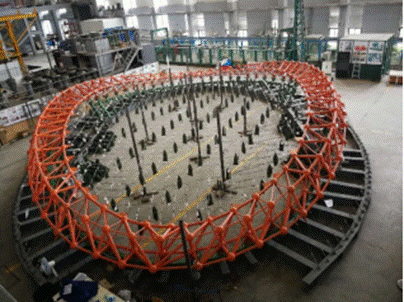
The super-large structural span and the complex mechanical performance of the overall roof steel structure have brought many challenges to the structural design and construction.
To simulate the stress conditions of the venue structure, the National Speed Skating Oval sought third-party professional services.Zhejiang University was commissioned to conduct a 1:12 model test and structural monitoring.
Real-time monitoring was carried out during the sliding of the ring truss, the tensing and lifting of the cable net, and other dangerous sub-projects to realize the closed circle of construction, acceptance and monitoring.
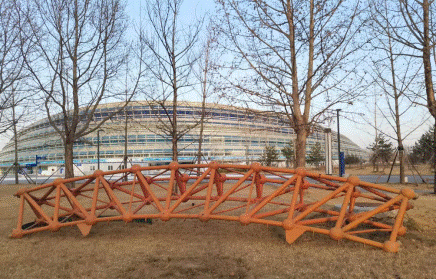
Solid model tests also allowed the company to research the static and dynamic performance of the cable net structure.
By measuring and analyzing the deformation and internal force change characteristics of the cable net, the company and Zhejiang University compared it with the simulation calculation results of the design model.The structural design scheme was tested and improved, and the effectiveness of the structural form comprehensive control measures to be adopted was validated.


